


Mid-Market Rate vs Bank Rate: What You’re Really Losing
 Panda AI
This guide explains the difference between the mid-market rate and the bank rate for NRIs sending money to India, and shows clearly how much money disappears in that gap on every transfer. Using simple calculations, it covers how to spot the markup your bank applies, why banks never call it a fee, and how PandaMoney gives NRIs the real mid-market rate with zero markup on every transfer.
Most NRIs who send money to India know there are fees involved. What most do not realise is that the fee on the receipt is not the highest cost. The real drain happens silently, inside the exchange rate your bank quotes you.
The mid-market rate vs bank rate gap is where the majority of your transfer cost hides.
What Is the Mid-Market Rate vs Bank Rate and Why Does the Gap Exist
The mid-market rate is the midpoint between buy and sell prices in the global foreign exchange market.
It is the rate at which financial institutions trade with each other at wholesale volume. Google, XE.com, and Reuters display when you search for any currency pair. It is real, and it is the most accurate representation of what a currency is worth at any moment.
The bank rate is the rate your bank offers you as a retail customer. It is always worse than the mid-market rate. Banks buy currency from you below the mid-market rate and sell it to you above it. The gap between the true market rate and what your bank charges is the exchange rate markup.
This markup is not illegal. It is not hidden in a technical sense. But banks do not call it a fee, do not list it on your receipt, and most customers never calculate it. That is the design.
How Banks Set the Bank Rate in the Mid-Market Rate vs Bank Rate Gap
Banks calculate the bank rate by applying a fixed or variable percentage spread to the mid-market rate. A typical spread for retail international wire transfers ranges from 2% to 3.5%, though some banks go higher on less liquid currency pairs.
The spread exists for several stated reasons:
- Risk management: Banks take on short-term currency exposure when they quote rates, and the spread compensates for that risk
- Operational costs: Processing international transfers involves compliance, infrastructure, and staffing
- Profit margin: Exchange rate markup is a major revenue line for retail banking globally, generating hundreds of billions annually
The honest framing: the mid-market rate vs bank rate gap is primarily a revenue mechanism. For NRIs transferring money to India, this markup is the single largest cost in every transfer, consistently larger than any visible fee.
How Much You Lose in the Mid-Market Rate vs Bank Rate Gap: Simple Maths
The best way to understand the mid-market rate vs bank rate gap is to calculate it on a real transfer amount. All examples use an approximate USD/INR mid-market rate of ₹95 per dollar (May 2026).
Calculating Your Real Cost in the Mid-Market Rate vs Bank Rate Comparison
Formula: (Mid-market rate minus Bank rate) divided by Mid-market rate, multiplied by 100 = Markup percentage

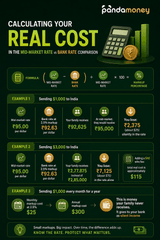
The rupee amounts vary with the actual mid-market rate on the day you send. The percentage loss stays constant as long as the markup percentage stays the same. At 2.5% markup, you always lose ₹2.375 for every ₹95 of value sent.
To understand why the exchange rate markup costs more than the visible wire fee and how to factor it into every transfer decision, this guide explains the full FX pricing mechanics.
Why the Mid-Market Rate vs Bank Rate Gap Is Never Called a Fee
This is the part of the mid-market rate vs bank rate discussion that frustrates most people when they first understand it. A $40 wire fee appears on your receipt. A 2.5% exchange rate markup on a $3,000 transfer costs $75 but appears nowhere. You simply receive a slightly worse exchange rate.
In most countries, financial regulators classify fees and exchange rate spreads differently. A fee must be disclosed clearly. An exchange rate spread is considered part of the pricing of a financial product, not a fee. This creates a legal grey zone that banks have operated in profitably for decades.
The result: when NRIs compare transfer options and look only at the fee column, they are comparing a fraction of the real cost. Two platforms can both advertise “zero fees” while one charges 2.5% in exchange rate markup and the other charges zero. The total cost is radically different, but the fee line says the same thing.
Regulatory progress is happening. The EU’s PSD2, the UK’s FCA, and the US CFPB have all moved toward greater rate transparency. But the gap between disclosure and what customers actually understand remains wide in practice.
How to Find the Mid-Market Rate vs Bank Rate in Real Time
Finding the mid-market rate takes seconds. Comparing it to your bank’s rate takes one more step. Together, they reveal exactly what the mid-market rate vs bank rate gap costs you.
Tools for Checking Mid-Market Rate vs Bank Rate Before Every Transfer
Step 1: Find the mid-market rate
Open any of these sources immediately before your transfer:
- Google: Search “USD to INR” and the top result shows the current mid-market rate
- XE.com: Real-time mid-market rates for all currency pairs
- Reuters or Bloomberg: Institutional-grade live rates
- Wise’s rate checker: Shows the mid-market rate and Wise’s fee separately
Step 2: Check your bank’s quoted rate
Log in to your bank’s international transfer portal and get a live quote for the same amount. The rate they quote is your bank rate.
Step 3: Calculate the markup
Use this simple formula:
Markup % = ((Mid-market rate minus Bank rate) divided by Mid-market rate) × 100
If the mid-market rate is ₹95.00 and your bank quotes ₹92.63: (95.00 – 92.63) / 95.00 × 100 = 2.49% markup
On a $5,000 transfer, that 2.49% costs you approximately $124.50 that never reaches your family.
This check takes under two minutes and reveals the real cost before you commit. Many NRIs who do this calculation for the first time switch platforms immediately.
How PandaMoney Closes the Mid-Market Rate vs Bank Rate Gap
PandaMoney gives NRIs the real mid-market rate on every transfer. Not close to mid-market. The actual rate you see on Google at the time of your transfer.
This works because PandaMoney routes through stablecoin rails (USDC/USDT) instead of the SWIFT correspondent banking network. The stablecoin maintains a 1:1 dollar peg throughout. There is no exchange rate exposure during transit, so there is no markup to cover.
What this means for a $3,000 transfer to India:
- Bank wire at 2.5% markup + $40 fee: $115 total cost, family receives ₹2,77,875
- PandaMoney at zero markup + zero fee: $0 total cost, family receives ₹2,85,000
- Difference: ₹7,125 more with PandaMoney on a single transfer
For NRIs sending $2,000 per month, that difference over a year equals approximately $600 in additional rupees reaching India instead of going to the bank revenue.
Every PandaMoney transfer also processes through its network of 16+ fully authorised banking partners in India, creating a FEMA-compliant inward remittance record on every transaction.
For a full breakdown of how bank wire, fintech, and stablecoin transfers compare on the India corridor, that comparison covers every major platform.
Download PandaMoney on Android or iOS.
FAQs: Mid-Market Rate vs Bank Rate
What Is the Difference Between the Mid-Market Rate and the Bank Rate?
The mid-market rate is the true interbank exchange rate, the midpoint between global buy and sell prices. It is what you see on Google or XE.com. The bank rate is what your bank offers you as a retail customer, which sits below the mid-market rate by a percentage that the bank keeps as revenue. That percentage is the exchange rate markup, typically 2% to 3.5% for international wire transfers.
How Do I Calculate How Much My Bank Is Charging in Exchange Rate Markup?
Subtract your bank’s quoted rate from the mid-market rate, divide the result by the mid-market rate, then multiply by 100. If the mid-market rate is ₹95 and your bank offers ₹92.63, the calculation is: (95 – 92.63) / 95 × 100 = 2.49% markup. On a $5,000 transfer, that costs you approximately $124.50 in hidden exchange rate loss.
Why Do Banks Not Show the Exchange Rate Markup as a Fee?
In most regulatory frameworks, exchange rate spreads are classified as part of the pricing of a financial product rather than a disclosed fee. This means banks are not legally required to label the markup as a cost, the way they label a wire transfer fee. Regulatory progress is happening in the EU and UK, but the markup remains largely invisible in most consumer banking interfaces.
Is the Mid-Market Rate Always Better Than the Bank Rate for NRIs?
Yes. The mid-market rate is the best possible rate because it reflects the true market value of the currency. Any rate below it means you are paying a markup. Some fintech platforms like Wise come close to mid-market with only a small percentage fee. Platforms like PandaMoney deliver the exact mid-market rate with zero additional fee. Traditional banks consistently sit 2% to 3.5% below mid-market.
How Does PandaMoney Offer the Real Mid-Market Rate With Zero Markup?
PandaMoney routes transfers through stablecoin rails (USDC/USDT) instead of SWIFT. The stablecoin maintains a 1:1 dollar peg during the entire transfer, so there is no exchange rate exposure during transit. Without that risk, there is no reason to apply a spread. The conversion to INR happens through PandaMoney’s authorised banking partners at the actual mid-market rate, with zero markup added at any point.
Disclaimer: This blog is for educational and informational purposes only. Exchange rate examples use approximate rates as of May 2026 and are illustrative only. Actual rates vary by platform, amount, and market conditions. PandaMoney facilitates all transfers exclusively through authorised and fully licensed banking and financial institution partners, ensuring full compliance with applicable RBI and FEMA guidelines. Always verify live rates with your chosen platform before sending. Verify RBI inward remittance guidelines at rbi.org.in.
Related Articles





GetPandaMoney Inc. is a financial technology company, not a bank. Our product and services are offered in partnership with regulated and licensed financial institutions in each jurisdiction that we operate in. Client(s) deal directly with our regulated partners through the platform provided by PandaMoney.
For any queries or grievances, please write to us at compliance@getpanda.money
131 Continental Dr Suite 305 Newark, DE, 19713 US
©2025 PandaMoney. All Rights Reserved.
GetPandaMoney Inc. is a financial technology company, not a bank. Our product and services are offered in partnership with regulated and licensed financial institutions in each jurisdiction that we operate in. Client(s) deal directly with our regulated partners through the platform provided by PandaMoney.
For any queries or grievances, please write to us at compliance@getpanda.money
131 Continental Dr Suite 305 Newark, DE, 19713 US
©2025 PandaMoney. All Rights Reserved.