


Purpose Codes for India Remittances: The Full 2026 Guide
 Panda AI
This guide covers everything NRIs need to know about purpose codes for India remittances in 2026. It explains what purpose codes are, why the RBI mandates them under FEMA, how they are structured, and which codes apply to the most common NRI transfer scenarios. Readers will learn how to choose the right code, what happens when they get it wrong, and how compliant platforms like PandaMoney handle this step automatically. Whether you send money for family support, property, or NRE account funding, understanding purpose codes protects your transfer and keeps your documentation clean.
Every NRI who sends money to India has, at some point, been asked for a purpose code. Most people pick one quickly and move on. A few get it wrong and face delays they never expected.
Purpose codes for India remittances are mandatory identifiers required by the RBI under FEMA. They directly affect how your transfer is classified, documented, and processed. Getting the right one matters more than most senders realise.
This guide explains everything clearly, so you never have to guess again.
What are the Purpose Codes for India Remittances
Purpose codes are alphanumeric identifiers that the RBI assigns to every type of international money transfer. They tell banks and regulators exactly why money is crossing borders, whether it is family support, a property purchase, an NRE deposit, or a business payment.
Every inward remittance into India must carry a purpose code. No exceptions. It applies whether you send $500 or $50,000.
India received a record $135.46 billion in foreign remittances in FY2024-25, making it the world’s largest remittance recipient. The RBI uses purpose codes to track every rupee of that flow, maintain accurate Balance of Payments data, and prevent misuse of the foreign exchange system.
Why the RBI Makes Purpose Codes Mandatory for India Remittances
The RBI mandates purpose codes under the authority of the Foreign Exchange Management Act (FEMA), 1999. Every Authorised Dealer (AD) bank in India must capture and report the purpose code on every incoming international transfer.
The reasons go beyond compliance:
- Tax classification: Different purpose codes attract different tax treatment. A salary transfer (P1401) is taxable income. A family maintenance transfer (P1301) is generally not
- Documentation accuracy: The purpose code determines what supporting documents your bank may ask for
- FIRC issuance: Your Foreign Inward Remittance Certificate or eFIRC, needed for GST compliance and tax filing, reflects the declared purpose code
- Regulatory reporting: Banks submit FETERS (Foreign Exchange Transactions Electronic Reporting System) data to the RBI, and every transaction in that report carries a purpose code
The official and most authoritative source for all-purpose codes is the RBI’s FEMA notifications and annexures.
How Purpose Codes for India Remittances Are Structured
Understanding the structure makes it easy to identify which category your transfer falls into.
All-purpose codes follow a simple format: a letter prefix followed by four digits.
- Inward remittance codes start with “P”: These cover money coming into India from abroad
- Outward remittance codes start with “S”: These cover money leaving India under the Liberalised Remittance Scheme (LRS)
As an NRI sending money to India, you will almost always deal with “P” codes.
Inward vs Outward Purpose Codes for India Remittances
The two categories serve completely different purposes:
Inward (P codes): Used when money flows into India. This is what NRIs use when sending funds to family, depositing into NRE/NRO accounts, funding property purchases, or receiving a salary from an overseas employer.
Outward (S codes): Used when residents send money out of India under LRS for education abroad, overseas property, foreign investments, or travel.
As an NRI sending money home, every transfer you initiate from the US, UK, or Europe falls under inward remittance and requires a P code. Your bank or PandaMoney will prompt you to declare the purpose before processing the transfer.
Most Common Purpose Codes for India Remittances NRI Use
These are the purpose codes that cover the vast majority of NRI personal transfers:

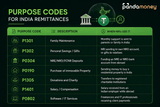
Always verify the exact code with your bank before sending. Purpose codes are updated periodically, and your bank’s forex team holds the most current list.
How to Choose the Right Purpose Code for India Remittances
Choosing the right code comes down to one question: why is this money moving?
Be specific. Vague answers lead to wrong codes. Here is a practical approach:
- Start with the nature of the transfer: personal, business, investment, or property
- Identify the exact reason: family support, NRE funding, property payment, salary
- Match it to the correct P code from the RBI list or your bank’s guidance
- Keep supporting documents ready, depending on the code selected
If unsure, contact your bank’s NRI forex team before initiating the transfer. They handle these codes daily and can guide you to the right one quickly.
Common Mistakes NRIs Make with Purpose Codes for India Remittances
Even experienced NRI senders make these errors:
- Using P1302 (gifts) for NRE account funding: NRE deposits have their own code (P0304). Using the wrong one creates a documentation mismatch that your CA will notice during repatriation
- Using a business code for a personal transfer: Mixing personal and business categories triggers compliance queries from both the bank and the RBI
- Picking the closest-sounding code without verifying: Codes like P1301 (family maintenance) and P1302 (savings/gifts) look similar but serve different documentation purposes
- Not informing the sender: The purpose code often needs to be entered on the sending side, too. If your overseas bank or PandaMoney records a different code than what your Indian bank expects, it creates a mismatch in the FETERS report
What Happens If You Use the Wrong Purpose Code for India Remittances
Using an incorrect purpose code is not a minor issue. It can delay access to your own money.
Short-term consequences:
- Your Indian bank places the funds on hold while it investigates the mismatch
- The bank requests a formal declaration or supporting documents before crediting the account
- In some cases, the transfer gets returned to the sender, triggering another round of fees and delays
Long-term consequences:
- An incorrect purpose code creates a flawed FIRC/eFIRC that does not match the true nature of the transfer
- If you later try to repatriate funds, a documentation mismatch in the original transfer record complicates the approval
- Repeated incorrect declarations can attract regulatory scrutiny from the RBI
Once the bank reports the transfer to the RBI, corrections require formal justification. Contact your bank immediately if you spot an error.
How PandaMoney Handles Purpose Codes for India Remittances
At PandaMoney, purpose code compliance is built into every transfer. You are never left guessing.
When you initiate a transfer through the PandaMoney app, the platform prompts you to select the purpose of your transfer from a clearly labelled list. It automatically maps your selection to the correct RBI purpose code.
Here is how PandaMoney makes this seamless:
- The app presents purpose options in plain language, not raw RBI codes
- Your selection maps directly to the correct P code in the backend
- Every transfer processes through PandaMoney’s network of 16+ fully authorised banking and financial institution partners, each licensed to handle FEMA-compliant inward remittances
- The resulting inward remittance record carries the correct purpose code, giving your CA the clean documentation trail needed for tax filing, repatriation, and property transactions
This authorised partner model matters. Purpose codes are only as reliable as the institution reporting them to the RBI. Because PandaMoney works exclusively through fully licensed Authorised Dealer partners, every declaration goes through regulated channels your Indian bank trusts.
For NRIs sending money for property purchases, the guide on FEMA rules and documentation for India property remittances covers the specific purpose code and compliance requirements for that use case. For those looking to fund an NRE account, the NRE account opening and funding guide walks through the complete process.
Download PandaMoney on Android or iOS.
FAQs: Purpose Codes for India Remittances
What Is a Purpose Code for India Remittances, and Is It Mandatory?
A purpose code is an RBI-assigned alphanumeric identifier that classifies why money is crossing the Indian border. It is mandatory for every inward and outward international transfer under FEMA. There are no exceptions based on amount or account type. Every transfer, personal or business, requires one.
Which Purpose Code Should an NRI Use for Sending Money to an NRE Account?
Use P0304, which covers NRE, NRO, and FCNR deposits. This is the correct code for any NRI funding their own Indian bank account from abroad. Using P1301 (family maintenance) or P1302 (savings/gifts) for NRE deposits creates a documentation mismatch that can complicate future repatriation approvals.
Can I Change a Purpose Code After the Transfer Has Been Processed?
It is difficult. Once the bank reports the transfer to the RBI via FETERS, a correction requires a formal written request, a declaration, and supporting documents explaining the error. Some banks process corrections within a few weeks. Others take longer. Always verify the correct purpose code before initiating the transfer to avoid this situation entirely.
Does the Purpose Code Affect Whether My Remittance Is Taxable in India?
The code does not create tax liability by itself. However, it signals the nature of the transaction to the tax authorities. A P1401 (salary) transfer is taxable income. A P1301 (family maintenance) transfer from a close relative is generally not taxable. Always consult a qualified CA to understand the tax treatment for your specific purpose code and transfer amount.
How Does PandaMoney Ensure the Right Purpose Code Is Used on Every Transfer?
PandaMoney prompts users to select their transfer purpose in plain language during the transfer flow. The platform automatically maps that selection to the correct RBI purpose code. All transfers then route through PandaMoney’s network of 16+ fully authorised banking partners, ensuring the purpose code is reported correctly to the RBI through licensed, FEMA-compliant channels.
Disclaimer: This blog is for educational purposes only and does not constitute legal, financial, or tax advice. Purpose codes and RBI regulations are updated periodically. PandaMoney facilitates all transfers exclusively through authorised and fully licensed banking partners, ensuring every transaction complies with applicable RBI and FEMA guidelines. Always verify the correct purpose code with your bank or a qualified CA before initiating a transfer. Refer to the official RBI purpose code list at rbi.org.in for the most current codes.
Related Articles





GetPandaMoney Inc. is a financial technology company, not a bank. Our product and services are offered in partnership with regulated and licensed financial institutions in each jurisdiction that we operate in. Client(s) deal directly with our regulated partners through the platform provided by PandaMoney.
For any queries or grievances, please write to us at compliance@getpanda.money
131 Continental Dr Suite 305 Newark, DE, 19713 US
©2025 PandaMoney. All Rights Reserved.
GetPandaMoney Inc. is a financial technology company, not a bank. Our product and services are offered in partnership with regulated and licensed financial institutions in each jurisdiction that we operate in. Client(s) deal directly with our regulated partners through the platform provided by PandaMoney.
For any queries or grievances, please write to us at compliance@getpanda.money
131 Continental Dr Suite 305 Newark, DE, 19713 US
©2025 PandaMoney. All Rights Reserved.