


What Is TCS on Foreign Remittances? 2026 Rules
 Panda AI
This blog is for educational and informational purposes only. It does not constitute legal, tax, or financial advice. Tax Collected at Source on foreign remittances is governed by Section 206C(1G) of the Income Tax Act, with rates and thresholds revised through the Finance Act, 2026, effective April 1, 2026. Specific rules around credit card spending, tour packages, education loans, and category classification can change with future Finance Acts. Readers should consult a qualified chartered accountant or tax advisor before making large foreign remittances.
If you have tried to send money abroad from India in the last few years, you have probably seen a sudden tax deduction on top of the amount you wanted to send. That deduction is TCS, or Tax Collected at Source, and it applies to almost every outward remittance made by a resident Indian.
The good news is that Budget 2026 cut TCS rates significantly for education, medical, and tour-package remittances. The bad news is that the rules are still confusing, and most people end up paying more TCS than they need to, simply because they do not understand the categories or the threshold.
This guide breaks down TCS on foreign remittances in 2026 in plain language: what it is, who pays, the latest rates, the legal ways to avoid it, and how to claim every rupee back when filing your income tax return.
What TCS on Foreign Remittances Actually Means in 2026
TCS stands for Tax Collected at Source. It is an advance income tax collected by an authorised dealer (your bank or forex provider) at the time you send money abroad. It was introduced under Section 206C(1G) of the Income Tax Act and applies to outward remittances made under the Reserve Bank of India’s Liberalised Remittance Scheme (LRS).
Three quick facts every sender should internalise:
- TCS is not an additional tax. It is your own income tax paid in advance, fully adjustable against your final tax liability
- The LRS overall cap is USD 250,000 per financial year for any resident Indian. TCS does not change this cap
- TCS applies only to resident Indians sending money abroad. NRIs sending money to India are not affected at all
The last point matters a lot. Many NRIs worry that TCS might apply when their family sends them money in the US, UK, or EU. It does not. TCS is a tax on outbound LRS remittances, and NRIs operate under separate FEMA rules through NRE and NRO accounts.
2026 TCS Rates on Foreign Remittances by Purpose
Budget 2026 introduced the most significant TCS rate cuts in years. The new rates took effect from April 1, 2026, and here is what they look like.

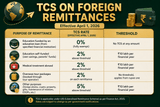
The big winners are students and patients. Education and medical TCS dropped from 5% to 2%. Tour package TCS also dropped from the older 5% and 20% split to a flat 2%, although tour packages still carry no threshold.
The category most people get caught by is the 20% rate on “other purposes”. This covers a huge range of common transfers including investments in US stocks, foreign mutual funds, cryptocurrency on international exchanges, overseas property purchases, gifts to relatives abroad, and ESOP exercise payments. If your remittance does not fit into education, medical, or tour packages, assume the 20% rate applies above ₹10 lakh.
How the ₹10 Lakh Threshold Works for TCS on Foreign Remittances
The threshold is cumulative across the financial year, not per transaction. This is the part that trips up most senders.
Suppose you remit:
- ₹4 lakh in April for your child’s overseas course fee (self-funded)
- ₹3 lakh in July for a foreign stock investment
- ₹5 lakh in October as a gift to a relative abroad
Your total LRS remittance for the year is ₹12 lakh. The first ₹10 lakh is TCS-free. The remaining ₹2 lakh attracts TCS at the rate that applies to whichever transaction crossed the threshold.
Two important nuances:
- Overseas tour packages sit outside this combined ₹10 lakh limit. They have their own 2% TCS from the first rupee
- The threshold resets every April 1. If you have a large remittance planned, splitting it across two financial years can keep you under the ₹10 lakh ceiling in each year
For NRI families with parents in India who are sending money out as gifts or as maintenance, the same rule applies. The cumulative ₹10 lakh threshold combines all categories except tour packages.
When TCS on Foreign Remittances Does Not Apply
Several common transfers are completely outside the TCS net. Knowing these saves real money.
International credit card spending abroad is currently outside LRS, which means no TCS applies. Use your credit card while travelling for hotels, restaurants, and shopping, and you skip the tax entirely. Debit card spending and forex card loading, however, fall under LRS and attract TCS once the threshold is crossed.
Education loans from specified institutions are fully TCS-exempt with no threshold. The Income Tax Act lists which institutions qualify, but most major Indian banks and recognised non-banking financial companies are included.
NRIs sending money to India are entirely outside TCS scope. The LRS applies only to resident Indians sending money abroad. If you are an NRI in the US, UK, or EU sending money to your family in India, no TCS is collected on your transfer. Our guide on what FIRC is and why every NRI needs to request it covers the compliance trail on the receiving side.
Repatriation from NRO accounts by NRIs back abroad is also not subject to TCS, although other rules like the USD 1 million annual cap and Form 15CA/15CB requirements apply. Our guide on NRO account repatriation and the USD 1 million annual limit explains the process.
Investments in domestic mutual fund schemes that internally invest in foreign stocks (international fund of funds available in India) are not LRS remittances and carry no TCS. This is one of the simplest ways to gain global equity exposure without TCS exposure.
How to Claim Back TCS on Foreign Remittances
TCS is never lost money, assuming you file your income tax return correctly. Here is how the refund mechanism works.
When your bank or forex provider collects TCS, it is deposited with the Income Tax Department against your PAN. You will see this deposit reflected in your Form 26AS and your Annual Information Statement (AIS) on the income tax portal.
At ITR filing time, three things can happen:
- If your total tax liability for the year is higher than the TCS collected, the TCS gets adjusted against your tax due and you pay only the balance
- If your total tax liability is lower than the TCS collected, you get the difference back as a refund
- If you have no taxable income, you get the full TCS back as a refund
The catch is the cash flow impact. A ₹20% TCS on a ₹15 lakh foreign stock investment is ₹1 lakh blocked until your refund comes through. For most filers, that refund arrives 2 to 6 months after filing, meaning your money is locked up for almost a year.
This is why understanding the categories and timing your remittances matters even if you eventually get every rupee back.
Smart Ways to Reduce TCS on Foreign Remittances Legally
Three practical strategies work for most senders.
Split large remittances across two financial years. If you have a ₹15 lakh transfer planned in March, sending ₹10 lakh in March and ₹5 lakh in April keeps you within the ₹10 lakh annual threshold in each financial year and eliminates TCS entirely. The March 31 to April 1 split is the single most useful tax move available.
Use education loans for overseas studies. Education loan-funded remittances carry zero TCS with no threshold. If you have a choice between self-funding from savings and taking an education loan, the loan route saves the immediate cash flow on TCS, even if you plan to prepay the loan later.
Use international credit cards while travelling. Direct credit card spending abroad is outside LRS in 2026 and carries no TCS. Loading large amounts onto forex cards before travel triggers TCS once the threshold is crossed. The credit card route is far more tax-efficient for travel expenses.
For NRIs whose families are sending money abroad to support them, our FEMA guide on transferring money to India for business investment covers the related compliance angles. Joint account holders should also see our guide on holding a joint NRE account with a resident Indian for the rules around shared finances.
How PandaMoney Fits into the TCS on Foreign Remittances Picture
PandaMoney is built primarily for NRIs sending money to India, where TCS does not apply at all. This is one of the clearest advantages of routing your transfers correctly: an NRI in the US, UK, or EU sending money to family or investments in India never sees a single rupee of TCS deducted.
What PandaMoney protects you from instead is the other big cost of cross-border transfers: hidden exchange rate markups and opaque fees, which can quietly drain 3% to 5% of your transfer value.
Every PandaMoney transfer routes through its network of 16+ fully authorised banking and financial institution partners in India:
- Real Google mid-market exchange rates, so 100% of your intended amount reaches India
- Zero hidden fees on supported corridors
- Direct deposit to any NRE, NRO, or savings account via IMPS or NEFT
- Clean FIRC paper trail generated by the receiving Indian bank for FEMA compliance
- Backend stablecoin rails for faster settlement, with no crypto wallet required from you
For the infrastructure side, see our explainer on how stablecoin rails work for international money transfers.
For a head-to-head comparison with traditional channels, our guide on Western Union vs bank wires vs fintech apps for India remittances covers the cost difference.
Download PandaMoney on Android or iOS and send your next India-bound transfer with full transparency.
FAQs: TCS on Foreign Remittances
Do NRIs Have to Pay TCS on Money Sent to India?
No. TCS applies only to resident Indians sending money abroad under the LRS scheme. NRIs sending money from the US, UK, EU, or anywhere else into India are entirely outside the TCS rules. Inward remittances to NRE or NRO accounts are governed by FEMA and bank-level reporting, not TCS.
What Are the New TCS Rates from April 1, 2026?
Yes, rates changed. Education and medical remittances now attract 2% TCS above ₹10 lakh (down from 5%). Overseas tour packages attract a flat 2% with no threshold. Other purposes like foreign investments, crypto, and gifts still attract 20% TCS above ₹10 lakh. Education loans remain fully exempt.
Is TCS on Foreign Remittances an Extra Tax I Lose?
No. TCS is your own income tax collected in advance and deposited against your PAN. You can fully adjust it against your tax liability when filing your ITR, or claim it as a refund if your total tax due is lower. The only real cost is the cash flow impact while you wait for the refund.
How Can I Avoid TCS on My Foreign Remittance Legally?
Yes, several ways exist. Keep total LRS remittances under ₹10 lakh per financial year, split large transfers across two financial years, use an education loan for overseas studies (fully exempt), and pay for foreign travel using an international credit card rather than loading large amounts onto a forex card.
Does TCS Apply to International Credit Card Spending Abroad in 2026?
No. International credit card spending while abroad is currently outside the scope of LRS, so no TCS applies. However, debit cards and forex cards loaded for foreign use fall under LRS and trigger TCS once the ₹10 lakh annual threshold is crossed. This rule is regularly reviewed, so confirm at the time of travel.
Disclaimer: This blog is for educational and informational purposes only. It does not constitute legal, tax, or financial advice. Tax Collected at Source on foreign remittances is governed by Section 206C(1G) of the Income Tax Act, with rates and thresholds revised through the Finance Act, 2026 effective April 1, 2026. Specific rules around credit card spending, tour packages, education loans, and category classification can change with future Finance Acts. Readers should consult a qualified chartered accountant or tax advisor before making large foreign remittances.





GetPandaMoney Inc. is a financial technology company, not a bank. Our product and services are offered in partnership with regulated and licensed financial institutions in each jurisdiction that we operate in. Client(s) deal directly with our regulated partners through the platform provided by PandaMoney.
For any queries or grievances, please write to us at compliance@getpanda.money
131 Continental Dr Suite 305 Newark, DE, 19713 US
©2025 PandaMoney. All Rights Reserved.
GetPandaMoney Inc. is a financial technology company, not a bank. Our product and services are offered in partnership with regulated and licensed financial institutions in each jurisdiction that we operate in. Client(s) deal directly with our regulated partners through the platform provided by PandaMoney.
For any queries or grievances, please write to us at compliance@getpanda.money
131 Continental Dr Suite 305 Newark, DE, 19713 US
©2025 PandaMoney. All Rights Reserved.